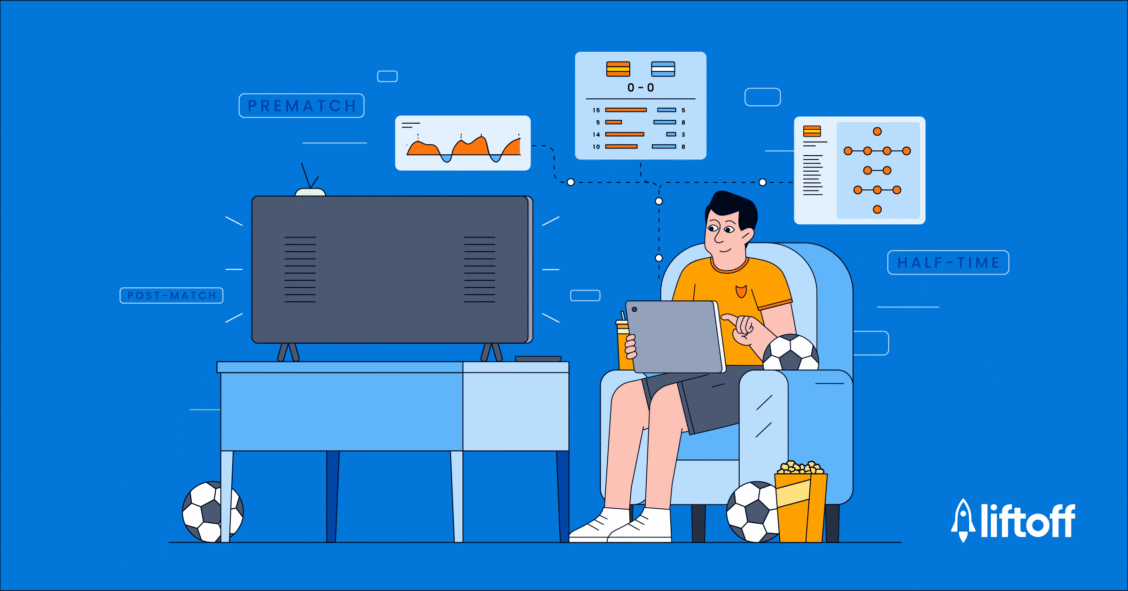
The World Cup audience doesn’t disappear during halftime. It picks up a phone.
What exclusive World Cup data reveals about planning brand campaigns across TV and mobile.
For decades, major sporting events have been planned around one screen.
The television.
It remains the emotional center of the experience, bringing millions of people together around the same live moment.
But today’s fans aren’t watching on just one screen.
During kickoff, halftime, controversial calls, and after the final whistle, they instinctively reach for their phones to check live scores, player stats, highlights, and reactions. The World Cup isn’t just a television event anymore. It’s a synchronized, multi-screen experience.
Second-screening has become a defining behavior of live sports, and eMarketer projects that 80% of US adults will use their smartphone as a second screen in 20261.
For brands, that changes where attention actually lives.
And during this year’s tournament, our data shows just how significant that shift has become.
What our data shows
Across sports scoring apps available through Liftoff’s SSP, Vungle Exchange, audience growth during the World Cup was immediate and substantial. These apps integrate Liftoff’s Vungle SDK directly, so the analysis reflects premium mobile supply from publishers with direct Liftoff relationships.
Compared to the period before kickoff2:
- Ad impressions nearly doubled (+90%)
- Unique audience grew ~40%
This wasn’t simply the same users spending more time in their favorite apps.
Millions of additional fans turned to scoring apps throughout the tournament, creating a significant increase in premium, non-gaming, SDK-direct inventory precisely when brands were competing for consumer attention.
And this is active attention, not background noise. Fans open these apps on purpose, to check a score, a lineup, or a stat in the moment. For brands, that creates a different kind of exposure: closer to the moment, more intentional, and tied to what fans are actively seeking.
One publisher tells the same story
The trend wasn’t unique to Liftoff’s marketplace.
BeSoccer, one of the world’s leading football companion apps and a Liftoff SDK publisher, experienced a similar surge in engagement throughout the tournament.
During the World Cup, BeSoccer reported3:
- Daily active users increased 63% on iOS
- Visits more than doubled, up 128%
- Screens viewed increased 71%
- Programmatic RPM increased 72%
BeSoccer’s results reinforce the broader pattern: fans consistently turned to trusted mobile companions to stay connected to the tournament beyond the television broadcast.
“The World Cup brought a wave of new and returning fans to BeSoccer. Daily users and visits climbed sharply throughout the tournament, and that engaged, real-time audience is exactly what makes moments like this valuable for advertisers.”
Isabel Molina, Chief Programmatic & Analytics Officer, BeSoccer
Why this matters for brand planning
What’s changed is how audiences experience them.
Television still provides the shared emotional moment. Connected TV extends that experience into digital environments.
But neither tells the whole story.
Today’s viewers don’t wait until the match ends to engage. They check lineups before kickoff, follow statistics during play, debate controversial moments on social media, and revisit highlights immediately after the final whistle.
The smartphone has become the companion screen for live sports.
For brand marketers, that creates opportunities to extend campaigns beyond the living room without losing the context or emotion of the event.
According to a study commissioned by Liftoff and conducted by strategy consulting firm Altman Solon, advertisers invested approximately $0.07 per user hour in third-party mobile apps in 2024, compared with $0.24 in connected TV and $0.38 in traditional TV4.
For brands, this creates an opportunity to complement television campaigns with premium in-app inventory that remains comparatively underinvested relative to the attention it commands.
This isn’t about replacing television.
It’s about recognizing that consumer attention no longer lives on one screen.
A practical shift for major event planning
The practical shift for World Cup and major-event planning is to treat these moments as multi-screen from the start.
Keep broadcast and connected TV as the anchor for the shared experience.
Then extend campaigns into mobile apps to reach the same audience when they naturally pick up their phones: before kickoff, during halftime, between matches, and after the final whistle.
If you’re investing to reach fans during a live sporting event, don’t stop at the TV screen. Reach the same audience in the trusted sports companion apps they open throughout the match for live scores, player stats, lineups, and highlights.
These channels aren’t competing.
They’re complementary.
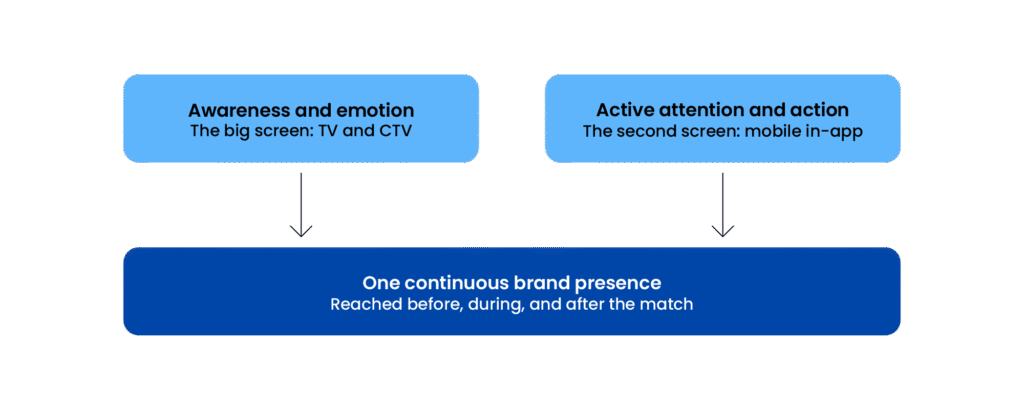
Television creates awareness and emotional impact.
Mobile captures attention during the moments when audiences actively seek more information and engage more deeply with the event.
Planning for both screens creates a more complete picture of how consumers actually experience live sports today.
Looking beyond the World Cup
While the World Cup is one of the world’s biggest sporting events, the lesson extends well beyond football.
Whether it’s the Olympics, March Madness, Formula 1, the NFL playoffs, or other tentpole moments, consumers increasingly divide their attention across multiple screens.
Brands that plan campaigns around that behavior can extend their reach into moments that traditional media plans often overlook.
The opportunity isn’t choosing between television and mobile.
It’s designing campaigns that recognize audiences already use both.
The future of sports advertising is multi-screen
Consumer behavior has evolved.
Media planning should evolve with it.
Major sporting moments are no longer confined to a single device. They’re shared across television and mobile in real time, creating new opportunities for brands to remain present throughout the consumer journey.
The audience doesn’t disappear during halftime.
It picks up a phone.
Ready for the next major sporting moment?
For brands and agencies, moments like this are only useful if they can be planned, packaged, and activated with confidence. Liftoff’s Vungle Exchange helps advertisers reach high-attention mobile audiences across premium, SDK-direct supply from publishers with direct Liftoff relationships.
To build an in-app plan for the next major sporting moment, get in touch with Liftoff’s Vungle Exchange team.
Sources
1 eMarketer, Second-Screen Engagement During Live Sports, April 2026.
2 Liftoff internal data, May 15th – July 8th 2026.
3 BeSoccer internal data. June 11 – July 13, 2026, compared with the previous period.
4 Altman Solon study commissioned by Liftoff, November 2025.