Creative in the AI era:
The new rules of creative performance
Part 1
Your creative workflow
has a problem
A creative strategist spends days on research: reviewing competitor ads, identifying audience signals, mapping hooks to formats. A copywriter shapes the angle. A brief goes to a designer. They produce a few concepts. The concepts get reviewed, revised, exported in a handful of variations, and shipped. A few weeks later, the creative starts to fatigue and performance plateaus. The UA manager requests a refresh. And the cycle repeats itself.
This workflow is one of the single largest constraints on mobile growth. The teams who have figured this out are not running the same process faster. They've rebuilt how creative gets made entirely. And the distance between them and everyone else is widening.
AI has rewired nearly every layer of mobile marketing. Creative is next.
Over the last decade, AI has moved through mobile marketing layer by layer. Auctions got smarter. Attribution got smarter. Bidding, targeting, identity, supply: all of it has gotten smarter thanks to machine intelligence.
Creative has been slower to follow. For high-investment formats like video and playables, GenAI adoption is still in early innings. The tools are maturing, the workflows aren't there yet, and the stakes are high enough that most teams aren't ready to hand over the keys. Where adoption has taken hold, it's largely in lower-complexity formats like image ads; a meaningful start, but not yet the full picture.
Now we're at an inflection point. Teams still producing creative the way they did in 2018, waiting for the right tooling to be defined and the next playbooks to be written, are being left behind.
The hidden costs of a manual creative workflow
01.
The lead-time tax
Every campaign in your portfolio moves at the speed of its slowest creative slot. If your average brief-to-ship time is 18 days, you have 18 days of lead time on every creative decision, every campaign, every quarter.
02.
The headcount ceiling
Variant volume scales linearly with headcount in a manual workflow. If your team can produce eight variants per designer per month, your maximum variant volume is your designer count times eight.
03.
The feedback lag
A manual workflow cannot generate variants fast enough to run tests at meaningful scale. Most teams ship two or three creatives, wait for signal, pick a winner, and repeat. But the impression volume required to reach statistical confidence takes weeks, and by the time a real winner emerges, the creative has already started to fatigue. The feedback loop is too slow to keep pace with what the campaign actually needs.
Data Moment
The top 25% of advertisers launch 53 or more creatives per week, with top spenders maintaining active portfolios of 5,000 to 10,000 simultaneously.
Source: Singular, "Creative Optimization Guide, 2026 Edition."
That is not a volume any manual workflow can sustain. The three constraints above are not edge cases. They're the expected result of applying a handcrafted production process to a demand curve that has fundamentally changed.
Operationalizing creative
wins with AI
Data Moment
56% of the top 100 grossing mobile games used AI in the design and production of their advertising assets in 2025.
Source: AppMagic, "Mobile Market Landscape 2026."
If the old playbook for mobile creative forced a tradeoff between craft and volume, the new one removes it. AI doesn't (and shouldn't) replace craft. Instead it frees teams to apply their creative taste and judgment across a much larger pool of work.
Expert View

“People underestimate the complexity of creative operations, and honestly, designers and artists have been undervalued in commercial work long before AI entered the conversation. The mistake I see most often is throwing AI at design and expecting a faster designer, or worse, a replacement for one. What we see is that you still need humans with taste directing and curating the work. AI is good at isolating, executing, and repeating patterns, but the work designers, directors, and strategists do isn't just execution. It's judgment. It's cultural context, brand intuition, a point of view that comes from real human experience. Where AI really earns its place is in scaling, testing, and iterating human-powered direction. Not transferring the work to AI, but amplifying what your team is already great at.”
The teams that stay ahead in this new era will be the teams whose creative workflow operates as a system: production, serving, and optimization moving together, with each layer feeding the next.
The rest of this guide walks through what that system looks like, layer by layer.
Part 2
What AI-powered creative
actually looks like
Three layers that have to work as a system.
AI plays three roles in modern creative production and strategy.
The industry conversation about AI and creative tends to collapse into one question: can a machine make an ad?
It’s the wrong question.
Instead, mobile marketing teams should look at the three distinct functions of AI in creative as a whole.
Generate: the creative factory. It turns a brief into a pool of viable variants.
Serve: the selection environment. It decides which variant, from the pool, gets shown to which user.
Optimize: the learning layer. It tightens the matching logic and feeds the next round of generation.
A team that nails generation but does nothing about serving is producing 200 variants and showing the same one to everyone. A team that nails serving but does nothing about generation is matching elegantly from a limited pool of creatives. A team that nails both but does nothing about optimization is running the same playbook quarter over quarter.
To find real traction, AI must sit at every layer of your creative workflow.
Generate
Generate creative faster at scale
AI does two things to creative production.
It lowers the cost of every variant. It raises the ceiling on how many variants are possible.
The volume gain is the bigger story. The cost reduction is what makes it accessible to teams that aren't in the top spending tier.
Manual workflow
Every variation has a per-unit cost in time and headcount
Teams concept, execute, and ship a small considered set
The question is what to make
AI-assisted workflow
That per-unit cost drops by an order of magnitude
Teams brief a creative space and generate inside it
The question is what to test
The industry framing of "AI gives you a strong first draft" suggests a finished product with minor edits. That's not how effective AI creative production works.
Effective production is a continuous loop, not a one-time act of creation.
Designers and strategists work with AI to find a new visual pattern or hook. Once that pattern is identified and repeatable, AI scales it across the next variants. By the time those saturate, the team is already on the next pattern. The work moves up the stack. Less time making variants. More time finding what is worth scaling next.
This insight reinforces where the real lift comes from: human strategists directing AI to generate holistically. The teams capturing the 19% gain are the ones using AI as a generative engine with human creative judgment steering the inputs, not as an editing layer on top of work that is already done.
Expert View

“If every advertiser scales the same workflow, will every advertiser's creative start to look the same? The answer matters because advertising's whole purpose is standing out. The teams that hold a creative edge will not be the ones that produce the most. They will be the ones whose pattern-finding stays a step ahead of what their AI workflows have already learned to replicate. The system commoditizes execution. It does not commoditize taste or innovation.”
AI is good at repeating what humans have already figured out. The hard part, and the human part, is figuring out what is worth repeating next.
Serve
Serve creative more effectively
Once teams unlock AI-generated creative, they have to decide what to do with it.
This is the layer the industry talks about least and the one most creative strategy teams dance around.
A creative library is only useful if the right creative reaches the right user.
Producing 200 variations and serving the same one to every user is just a more expensive version of the manual workflow.
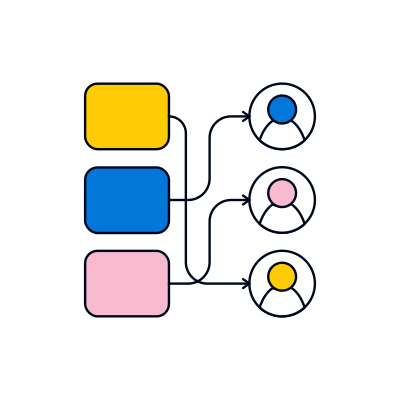
The serving layer is the system that solves for matching.
It takes contextual signals from the bid request, the user, the surface, and the moment, and decides which creative variation from the available pool has the highest probability of converting.
What the industry promises
Real-time creative assembly. A unique ad built for each user on the fly. Personalization at the individual level.
What serving actually delivers today
Matching from a library. The system picks the best creative from a pool that already exists, based on contextual signals.

Optimize
Optimization is key
The third layer is where the system compounds.
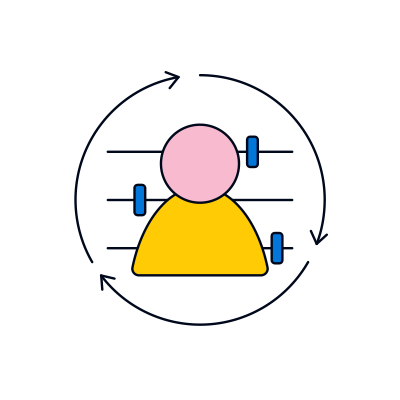
AI-generated creative gives teams variation. AI-powered creative serving distributes it. And AI-powered optimization learns from what happened, feeds that signal back into both, and makes the next round smarter than the last.
Three signals move through the optimization layer.
01.
Finding a common thread between winning ad creatives.
Teams running a small scale of variants per campaign tend to think of optimization as picking a winner and scaling it. That works until the winner fatigues, which it always does. Teams operating at real volume need to be asking a different question after every winning ad. What attribute did this winner carry? Answering that question is what a real optimization layer needs to do, and it is the gap most of the industry is still working to close.
02.
"Make more like the winner" is the wrong instinct.
When a variant outperforms, the natural move is to create more like it. That instinct produces a library that drifts toward sameness, which goes stale sooner. The better move is to understand why it won: what motivational driver it tapped, what the audience was responding to about the experience the ad was promising. Variants that share that underlying driver in combinations that haven't been tested will outperform variants that just copy the surface. That requires the optimization layer to do real pattern analysis, and most teams and most platforms skip that step today.
03.
Perfect recall is what the system has to bring. No team has it on their own.
A real optimization layer has to remember every variant, every match, every outcome across every context. The team's taste is still the input. What the system has to do is make sure that taste, once expressed, gets applied with consistency to the next ten thousand decisions the team will not be in the room for. That bar is the test of whether an optimization layer is real or just a label.
Creative Intelligence, exclusively for Liftoff partners
Your next install is one motivation away. Creative Intelligence, powered by GameRefinery's gaming intelligence platform, shows you which one.
Schedule a demo with your Liftoff Account Manager today.

Expert View
“The concern I hear most from creative directors is about brand integrity: that generating thousands of variants means loosening your grip on something you've spent years building. What I've seen is the opposite. The patterns the system learns and repeats are the ones your team already established. And more than that, creative directors start seeing evidence for things they'd always intuited but couldn't prove. AI doesn't replace that instinct. It gives it a scientific foundation without asking your team to become data analysts.”
So how do you recognize a creative partner that can deliver smart creative for the AI era?
Part 3
The checklist
Five questions to ask any creative partner you’re evaluating in 2026
Every vendor says they have AI.
This checklist is how you tell them apart.
At this point, every partner deck looks the same. Generation feature. Personalization line. Optimization promise. The vocabulary has converged so completely that it no longer tells you anything.
The five questions below are designed to cut through that noise. Use them against any vendor, any demo, any deck. If they can't answer one, or answer it in vocabulary instead of mechanics, pay attention to that signal.
Can you generate creative at the volume the workflow now requires?
Can you serve from a library, not just a single asset per campaign?
Do you have a working feedback loop between performance and the next round of creative?
Do all three AI-assisted layers live in the same decisioning system?
Do you have cross-vertical learning that no single advertiser can replicate?
You are working with a workflow, not a system.
Your score 0/5
Most partners in the market today can answer one or two of these credibly. A smaller number can answer three. A very small number can answer all five.
Liftoff Creative is built to answer yes to all five.
Industry Voice

Industry Voice

Industry Voice
