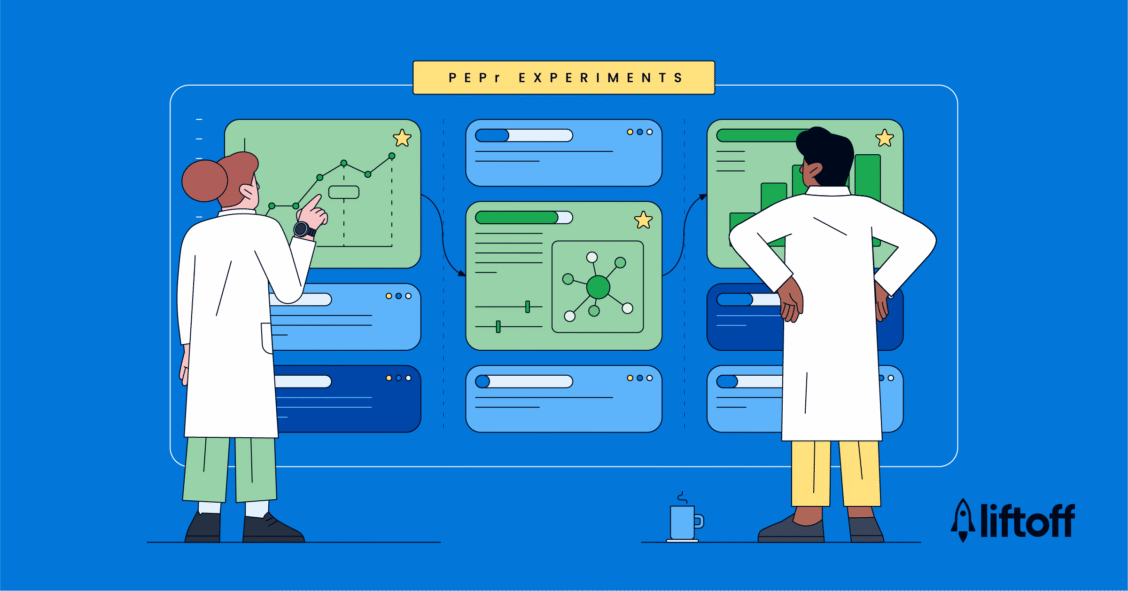
PEPr: Structured experimentation that scales
Experimentation remains one of the most powerful levers in performance marketing, particularly as market conditions grow more complex and competitive. But experimentation without structure rarely delivers lasting impact.
At Liftoff, our Performance Experimentation Program, PEPr, is designed to bring discipline to testing, helping advertisers prioritize high-impact initiatives, validate results with confidence, and scale what works in a repeatable way.
To understand how that structure translates into real-world execution, we sat down with David Wall, a lead Performance Strategist on the PEPr team. He shares how experiments are prioritized, how outcomes are validated, and why consistency, not just innovation, drives long-term performance gains.
Can you share your role on the PEPr team and how you support advertisers through the experimentation process?
I serve as the regional lead for the PEPr program in EMEA, where I help coordinate and operationalize experimentation across our platform. My role spans both strategy and execution. On a quarterly basis, we define the experimentation menu, ensuring it reflects our clients’ priorities and the needs of the region. We are also responsible for maintaining best-practice standards across the full lifecycle of each initiative, from experiment design and setup through to reporting and qualification.
At the advertiser level, I support the internal experiment leads by advising on hypothesis development, test structure, and performance evaluation. I am also closely involved in program-level reporting, ensuring insights are clearly documented and that successful initiatives are positioned to scale more broadly. Ultimately, my role is to ensure experimentation is clear, consistent, and genuinely actionable for our advertisers.
From your perspective, what makes structured experimentation so critical in today’s performance environment?
Performance marketing today is significantly more complex than it was even a year ago. Shifts in consumer privacy, auction dynamics, creative formats, and competitive intensity have made the landscape far less predictable. In that environment, relying on instinct or isolated tests is no longer enough.
A structured approach brings much-needed discipline to that complexity. Every initiative begins with a clear hypothesis, defined success metrics, and a clean, controlled setup. That structure allows us to distinguish genuine performance impact from short-term volatility. More importantly, it creates consistency. When experiments are conducted within a standardized framework, we can compare results across regions, verticals, and timeframes. That’s what allows a single test to turn into something we can confidently apply more broadly. Without structure, testing becomes reactive. With structure, it becomes something we can rely on and build on over time.
How does the PEPr team decide which experiments to prioritize?
Prioritization begins with impact. Each quarter, we build an experimentation menu around initiatives that offer clear strategic relevance and meaningful upside. We ask a few critical questions: If this works, can it scale? Does it align with broader product or commercial priorities? Will the outcome generate learning that can be applied across multiple advertisers?
We also incorporate bottom-up input, including direct client feedback. Our goal is to solve meaningful challenges for advertisers and ensure that what we build is grounded in real market demand. In parallel, we collaborate with cross-functional partners across Product, Sales, and Marketing to ensure experimentation supports broader business initiatives.
Team members regularly submit ideas based on what they are seeing in-market. Those proposals are reviewed by the regional leads to confirm they are hypothesis-driven, operationally feasible, and aligned with program objectives before being added to the quarterly roadmap. That balance keeps our roadmap grounded in real market needs while still aligned with our broader strategy.
How do you balance quick, tactical experiments with longer-term strategic tests?
Within PEPr, we group initiatives into two categories: Discovery and scale. Discovery initiatives are focused on learning. These are typically new or unproven ideas where the primary objective is to test a clear hypothesis and generate actionable insight. Because these concepts have not yet been validated, they often carry greater volatility and require tighter controls. At this stage, success isn’t just about performance; it’s about understanding what worked, why it worked, and whether we can apply it elsewhere.
A recent example of this is rewarded targeting, where we tested including or excluding rewarded placements based on historical performance. The goal was to better understand how rewarded inventory impacts engagement and conversion, and whether more deliberate control over its use could drive improved performance.
Scale initiatives, by contrast, are built on proven foundations. These strategies have already demonstrated success through prior testing and are now focused on driving incremental impact while delivering innovative, repeatable solutions for advertisers. The focus shifts from proving it works to scaling it responsibly.
For example, our iOS 26 promo campaigns were launched after resolving an issue that allowed us to buy more effectively on iOS 26 ahead of competitors. This created an opportunity to deploy incremental budget into a less competitive environment and scale performance efficiently.
The two approaches work together. Discovery initiatives feed scale by identifying high-potential concepts that can be applied more broadly. Scale initiatives, in turn, create the stability and incremental gains that allow us to continue investing in new Discovery efforts. That balance ensures PEPr isn’t just about trying new things, but about building something that compounds over time.
How does the team define success within PEPr?
Success is defined at the outset. Every initiative begins with a clear hypothesis and predefined KPIs, ensuring we are aligned on what we are measuring and why. Without that clarity, it’s difficult to evaluate results with confidence.
For a result to be considered validated, it must demonstrate measurable impact against those agreed metrics, supported by clean execution and sufficient stability to rule out short-term fluctuations. We also assess repeatability, evaluating whether the outcome can be confidently applied beyond a single test environment.
At the end of the day, validation comes down to whether we can clearly explain the impact and replicate it. If we can clearly articulate the outcome, understand what drove it, and repeat it reliably, then the initiative is ready to scale, whether that means broader adoption within PEPr or integration into evergreen campaign strategies.
What are common misconceptions advertisers have about experimentation?
One common misconception is that any account change qualifies as experimentation. True experimentation requires structure, including a defined hypothesis, agreed success metrics, and a controlled environment to accurately measure impact. Without those elements, it becomes difficult to attribute outcomes with confidence.
Another misconception is the expectation of immediate results. Many experiments require time to stabilize, and early volatility does not necessarily signal failure. Patience and disciplined evaluation are often essential to uncover meaningful insights.
There is also a tendency to treat a single positive outcome as universally applicable. In reality, context plays a significant role. Budget levels, market conditions, vertical dynamics, and account maturity all influence performance. Experimentation isn’t about chasing quick wins. It’s about building approaches that we can test, refine, and scale over time.
What trends are you seeing in how advertisers approach testing today compared to a year ago?
Compared to a year ago, advertisers are increasingly focused on testing that delivers measurable performance improvement and unlocks incremental budget. Experiments are no longer evaluated solely on learning value. They are assessed on their ability to drive efficiency gains or scalable growth.
There’s a clear shift toward testing that proves its value. Advertisers want confidence that performance improvements are durable and repeatable, because validated uplift is what ultimately earns greater investment. As a result, experimentation is now expected to show clear incremental value, not just generate learning.
From testing to scalable impact
Experimentation is not about isolated wins or one-off tests. It is about building a consistent operating model that allows teams to test intentionally, learn with clarity, and scale with confidence.
As complexity increases across the performance landscape, that consistency becomes a competitive advantage. When insights are validated, documented, and repeatable, they can be applied across markets, verticals, and campaign types to drive sustained impact.
If you would like to learn how the PEPr program can benefit your campaigns and help you reach your goals, connect with the Liftoff team to start the conversation.