Apps and Trends to Watch: Engagement strategies fueling Learna and Pengu’s rise
App growth grabs headlines. But understanding what actually drives that growth (retention mechanics, habit loops, and monetization systems) is often where smarter strategy begins.
In this installment of our Apps and Trends to Watch series, I’m looking at two fast-rising apps that show how familiar engagement mechanics can drive breakout performance when applied in the right context. In previous installments, we explored how entertainment apps like AirBuds and FlareFlow built momentum through social-first design and daily engagement loops, and how prediction market platforms such as Kalshi and Polymarket blended financial mechanics with gamified habit systems. Learna and Pengu continue that broader theme from a new angle.
Whether it’s an AI-powered tutor or a co-parented digital pet, Learna and Pengu demonstrate that many powerful innovations are often rooted in proven behavioral playbooks.
What stands out isn’t that these apps invented entirely new systems. It’s that they’ve thoughtfully adapted well-established engagement mechanics to new contexts, pairing AI tutoring with habit loops and social networking with game design systems.
Before looking at how that plays out in practice, it helps to define what we mean by engagement mechanics.
What are engagement mechanics?
Engagement mechanics are product features designed to reinforce user behavior and increase retention. Common examples include streaks, progression systems, in-app currencies, social accountability features, and LiveOps events.
How do engagement mechanics support app growth?
Engagement mechanics support app growth by increasing retention, reinforcing daily habits, and strengthening monetization loops. When users feel progress, accountability, or momentum, they are more likely to return, and returning users help fuel sustainable growth.
Across categories, we continue to see the same pattern: when developers pair a compelling core value proposition with habit-forming mechanics, growth typically follows. As we’ve seen in previous installments, retention systems often matter just as much as the core product itself.
Streak systems, visible progression, gamified currencies, cooperative features, these are not new ideas. But when they’re layered onto emerging technologies like AI tutoring or reframed within social experiences, they can create powerful daily rituals. Learna and Pengu offer two very different examples of this strategy in action.
Learna: Turning AI tutoring into a daily ritual
Learna has quickly climbed the ranks in the Education category. Since early November, it has consistently ranked among the top five Education apps in the US iOS charts, with only brief dips at the end of December. Its rapid ascent, accompanied by strong download momentum and revenue growth, highlights how effectively it combines AI-powered learning with proven engagement psychology.
From my perspective, Learna’s success reinforces an important point: in edtech, even the most advanced AI tutor is only as strong as its ability to build a consistent habit.
The engagement playbook: Streaks and progress visibility
Learna’s core loop is built on two highly effective mechanics: a visible streak system and detailed progress tracking.
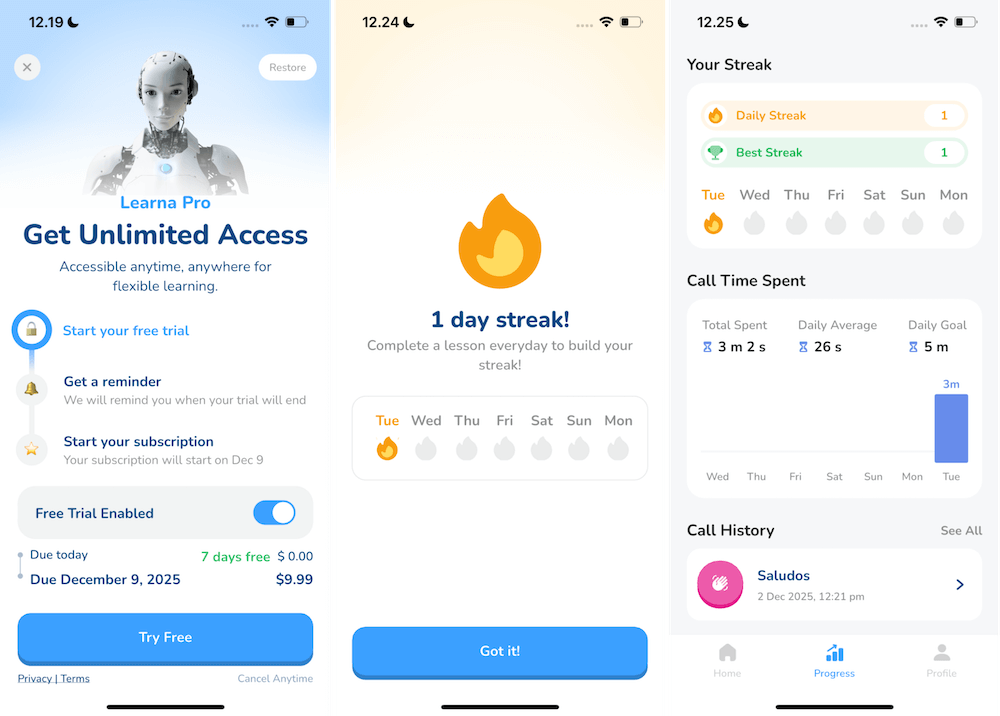
- The streak system: Like leading language-learning apps, Learna prominently displays a daily streak on the user dashboard. By showing both a “Daily Streak” and a “Best Streak,” it leverages loss aversion, missing a day feels like breaking momentum. Even new users are immediately rewarded with a celebratory “1-day streak,” reinforcing early commitment.
- Visual progress tracking: Learna also ensures that effort feels measurable. Users receive instant feedback through statistics like “Call Time Spent,” visualized via bar charts that track daily averages against a defined goal (for example, five minutes per day). Vocabulary practice is similarly quantified, with counters for new and upcoming words that make progress toward mastery tangible.
The mechanics themselves aren’t groundbreaking, but their execution transforms what could be a sporadic learning activity into a structured daily habit.
Learna
What Learna signals
Learna is a reminder that innovation doesn’t always mean inventing new engagement systems. By applying familiar habit-building strategies to AI tutoring, it turns an otherwise solitary activity into a sticky daily ritual.
For developers, the lesson is clear: emerging technology needs behavioral scaffolding to help sustain growth.
For app marketers, Learna highlights something equally important. When habit loops are clearly visible , they create strong retargeting hooks and creative angles. Messaging that reinforces momentum like “Keep your streak alive” or showcases measurable improvement can align perfectly with the product’s internal psychology. In other words, the more structured the engagement loop, the more precise lifecycle marketing can become.
Pengu: Blurring the line between social app and game
If Learna gamifies self-improvement, Pengu gamifies connection.
The app has steadily moved up the Social Networking charts, emerging as one of the stronger performers in the category as downloads and revenue continue to grow. At first glance, Pengu taps into 90s virtual pet nostalgia. But its real innovation lies in how it modernizes that concept for a social-first generation.
Their twist: you don’t raise the penguin alone.
Social accountability meets deep gamification
Pengu doesn’t rely on a single retention driver. Instead, it layers social obligation with systems more commonly found in mobile games.
Shared responsibility (co-op mode)
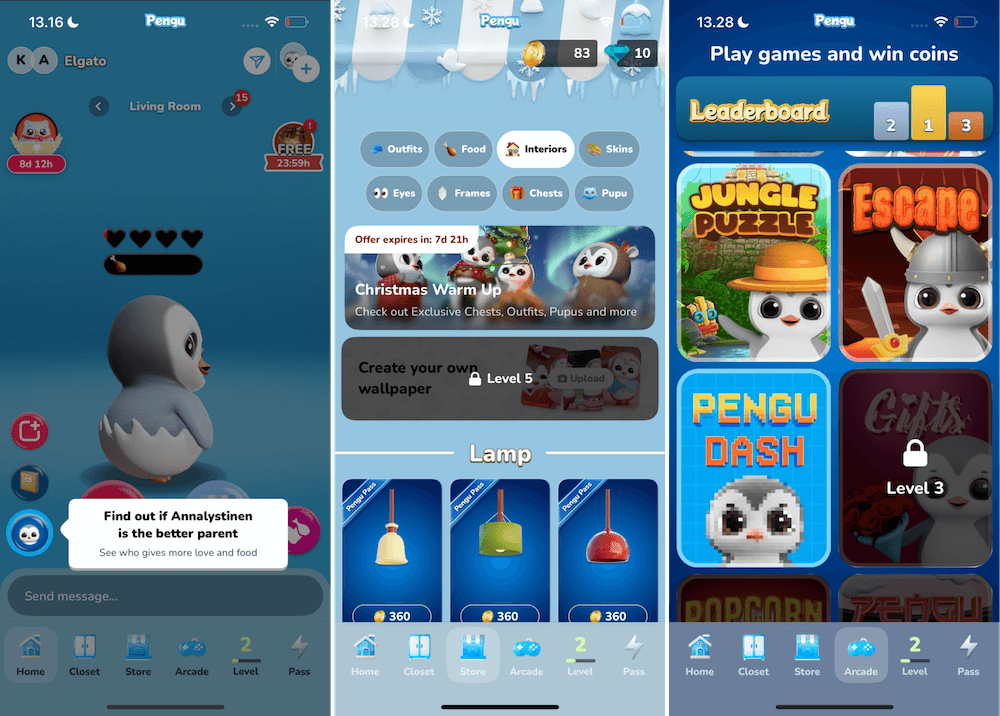
Pengu’s central mechanic is co-parenting a virtual penguin with a friend or partner. The app tracks contributions, including who feeds it more, who shows more affection, and even playfully prompts users with questions like “Who is the better parent?”
This introduces social accountability into the retention loop. If a user disengages, they not only neglect their digital pet; they’re letting down their co-parent. That subtle pressure strengthens daily participation.
A dense feature stack
While many social apps prioritize simplicity, Pengu embraces depth. It incorporates:
- Progression systems: Users earn XP and evolve their penguin from “Hatchling” to higher stages, unlocking new interactions.
- A dual-currency economy: Coins and Gems power cosmetics, gacha-style mechanics, and extensive customization, from igloo interiors to outfits, driving monetization.
- LiveOps and minigames: Seasonal events like “Christmas Warm Up” and in-app arcade games extend session length and create new engagement entry points.
The result is an app that feels as much like a mobile RPG as a traditional social network.
Pengu
What Pengu signals
Pengu helps demonstrate how rapidly the boundaries between categories are dissolving. By combining cooperative mechanics with deep gamification, it transforms a simple social concept into a highly monetized, engagement-heavy ecosystem.
For developers, the takeaway is that social obligation can be a retention multiplier. When users feel accountable to someone else, not just themselves, daily engagement becomes more resilient.
For app marketers, this kind of socially anchored engagement opens new acquisition and creative opportunities. Co-op mechanics lend themselves naturally to referral strategies, paired-user acquisition campaigns, and creative that emphasizes shared experiences rather than solo play. In addition, a dense feature stack creates multiple audience segments, allowing marketers to tailor messaging to competitive users, collectors, decorators, or casual participants differently.
App growth lessons from Learna and Pengu
Taken together, Learna and Pengu highlight a broader pattern in today’s app ecosystem: breakout growth often comes from applying proven engagement mechanics to new categories.
Learna shows how established habit-forming mechanics can stabilize and scale emerging technologies like AI tutoring. Pengu illustrates how game design systems can deepen monetization and retention within social apps.
Both reinforce the idea that breakout growth doesn’t always come from reinventing engagement. More often, it comes from reapplying proven systems to new categories or audiences.
The next breakout hit may not be built on a brand-new mechanic. It may simply apply a familiar one to a problem that hasn’t yet been fully gamified or socially activated, and marketers who understand those mechanics early will be better positioned to scale it.
Looking for more exclusive insights into the drivers of app growth, retention strategies, and monetization trends? Schedule a free demo with AppRefinery today.