What is a demand-side platform (DSP)?
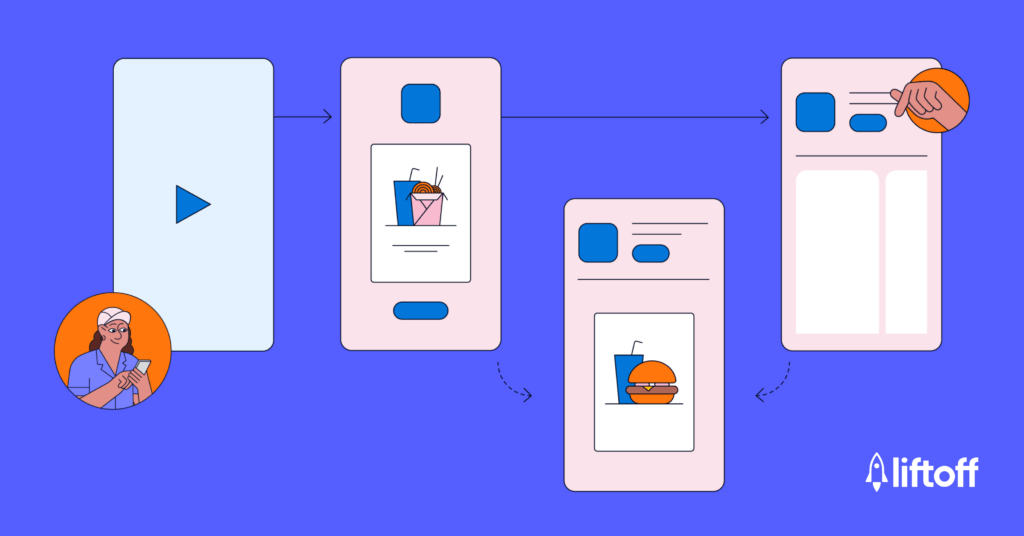
A demand-side platform (DSP) is software that allows advertisers to buy digital ad inventory automatically across multiple channels from a single interface. DSPs connect to ad exchanges, supply-side platforms (SSPs), and publisher networks to purchase ad impressions in real-time auctions, using audience data to reach the right users at the right moment while giving advertisers centralized control over budgets, targeting, and campaign performance.
For mobile app advertisers specifically, a DSP is the engine behind programmatic user acquisition. It automates the process of bidding on in-app ad inventory at scale, across thousands of apps and publishers simultaneously, in a way no manual buying process could replicate.
How a demand-side platform works
When a user opens a mobile app and an ad slot becomes available, the SSP’s SDK embedded in the app detects the opportunity and fires a bid request to connected DSPs, typically via the SSP’s own auction exchange. The SSP and ad exchange functions are often handled by the same platform in modern mobile programmatic infrastructure. Each DSP evaluates the opportunity against the advertiser’s campaign parameters: audience match, bid price, placement type and quality, budget pacing, and optimization goals. If the impression qualifies, the DSP submits a bid. The exchange selects the winner, typically the highest bid that clears the publisher’s price floor, and the ad is served before the page or screen finishes loading.
Per the IAB Tech Lab’s OpenRTB specification, this entire request-response cycle is standardized so that buyers and sellers can transact at machine speed across a fragmented ecosystem of publishers. The whole process typically completes in under 100 milliseconds.
The DSP feeds performance data back into its bidding algorithms. Every install, in-app event, or conversion signal informs future bid decisions, tightening targeting over time and improving return on ad spend (ROAS).
Key components of a demand-side platform
A DSP is not a single feature. It is an interconnected stack of systems that each serve a distinct function:
Bidding engine: The core decision layer. It evaluates each incoming bid request, calculates the expected value of the impression, and determines whether to bid and at what price. Modern DSP bidding engines run on machine learning models trained on campaign performance data, adjusting bid levels continuously across thousands of auctions per second. Because two DSPs can access the same impression and bid very differently based on what their models predict a user is worth, the intelligence behind the bidding engine matters as much as inventory access.
Audience targeting: DSPs considers targeting parameters to every bid request: device type, operating system, geography, app category, behavioral data, and first-party audience segments. For mobile advertisers, targeting also includes signals like device model, connection type, and in-app behavioral context.
Inventory access: A DSP connects to multiple ad exchanges simultaneously, giving advertisers access to a wide pool of publisher inventory from a single interface. Buys can happen through open auction (RTB), private marketplace deals (PMPs), or programmatic guaranteed placements.
Creative management: DSPs serve and manage ad creatives across formats: banners, interstitials, native, and mrec. For mobile campaigns, creative performance is a major optimization lever, and most DSPs surface creative-level reporting to help UA teams identify what is and is not working.
Measurement and reporting: DSPs provide campaign dashboards tracking impressions, clicks, installs, events, and cost metrics in near real time. For mobile, this layer integrates with mobile measurement partners (MMPs) like AppsFlyer, Adjust, and Singular to attribute installs and downstream events back to specific campaigns and creatives.
Brand safety and fraud controls: DSPs apply pre-bid filters to exclude low-quality or fraudulent inventory. Given that DoubleVerify’s 2025 North America report found bot fraud surged 101% year over year in 2024, with the U.S. up 106%, these controls are not optional for serious mobile advertisers.
Types of demand-side platforms
Not all DSPs are built for the same use case. It helps to think about DSPs across two dimensions: what inventory they specialize in, and how they are serviced.
By inventory focus:-
General-purpose DSPs connect to broad cross-channel inventory covering display, video, mobile web, in-app, CTV, and audio. They are designed for advertisers running campaigns across multiple formats and environments.
Mobile-focused DSPs are purpose-built for in-app advertising. They prioritize app store data, device-level signals, MMP integrations, and mobile-specific formats like rewarded video and playable ads. For mobile UA teams, a mobile-native DSP typically outperforms a general platform on in-app inventory because its bidding models are trained specifically on mobile engagement patterns.
By service model:-
Self-serve DSPs give advertisers direct access to the platform: they set budgets, targeting, bids, and creatives themselves. These suit in-house UA teams with programmatic expertise.
Managed-service DSPs pair platform access with a team that runs campaigns on the advertiser’s behalf. These suit teams without deep programmatic expertise or those running large, complex campaigns where a managed layer adds value.
A mobile-focused DSP can be self-serve or managed, and so can a general-purpose one. The two dimensions are independent, and the right combination depends on your team’s in-house expertise and the inventory environments you are prioritizing.
Why demand-side platforms matter for mobile UA
The scale argument is straightforward. A mobile app advertiser reaching users manually, publisher by publisher, could not get anywhere near the reach, speed, or targeting precision that a DSP provides. DSPs access inventory across thousands of apps simultaneously, evaluate each impression individually, and make bid decisions in real time.
But the more compelling argument is optimization. A well-configured DSP does not just buy impressions. It learns. Bidding algorithms trained on install and in-app event data continuously improve campaign efficiency, steering budget toward the inventory and audiences most likely to convert.
According to eMarketer’s 2025 programmatic forecast, programmatic will account for 90% of all global digital display ad spending by 2026. In the US specifically, eMarketer projects programmatic digital display ad spending to exceed $180 billion in 2025, representing approximately 92% of total US digital display ad spend. Mobile already accounts for the majority of that programmatic spend. For mobile UA teams, this is not a future-state scenario: it is the current infrastructure for growth.
DSP vs SSP: the buy side vs the sell side
A DSP and a supply-side platform (SSP) are complementary tools on opposite sides of the same transaction.
A DSP serves advertisers. It is the tool for buying: planning campaigns, setting targeting, submitting bids, and measuring results. The advertiser’s goal is to reach valuable users efficiently.
An SSP serves publishers and app developers. It is the tool for selling: packaging ad inventory, setting floor prices, connecting to multiple demand sources, and maximizing revenue per impression.
The two platforms meet at an auction. When a user triggers an ad opportunity inside an app, the SSP detects the available slot and sends a bid request to connected DSPs. Each DSP evaluates the impression against active campaign criteria and submits a bid. The SSP selects the highest bid that clears the publisher’s price floor, and the winning ad is returned to the publisher. The impression is filled.”
As the IAB Tech Lab defines it, real-time bidding is the mechanism that standardizes this handshake, allowing buyers and sellers to transact across a fragmented ecosystem without custom integrations.
| DSP | SSP | |
| Serves | Advertisers and agencies | Publishers and app developers |
| Primary goal | Buy impressions efficiently | Sell inventory at maximum yield |
| Optimizes for | ROAS, CPI, CPA, ROAS | Fill rate, CPM floor, revenue |
| Key inputs | Audience data, bid strategy, creative | Inventory metadata, floor prices, demand sources |
| Mobile role | Buy in-app ad inventory | Monetize app ad placements |
| Connects to | Ad exchanges, SSPs, data providers | Ad exchanges, DSPs, demand sources |
For a more in-depth dive into the difference between DSPs and SSPs, check out our comparison blog here. <hyperlink to DSP vs SSP blog once published>
DSP vs ad network: what is the difference?
Ad networks and DSPs both give advertisers access to publisher inventory, but they work differently.
An ad network acts as an intermediary: it aggregates inventory from publishers, bundles it into segments, and sells packages to advertisers. The advertiser buys a category (e.g., “gaming apps” or “finance apps”) rather than individual impressions. Pricing is typically a fixed CPM or CPC, and the network takes a margin.
A DSP operates at the impression level. Every bid is evaluated individually in real time, against the specific user, placement, and context of that one impression. The advertiser has full visibility into where their budget is going, at what price, and with what result.
As Geomotiv noted in their 2026 ad network vs DSP analysis, the core trade-off is control vs. simplicity: ad networks prioritize ease of buying, while DSPs provide granular control, transparency, and impression-level optimization.
For mobile UA teams running performance campaigns at scale, DSPs generally offer a material advantage: you are bidding on each user individually, with full data transparency, rather than buying pre-packaged audience buckets from a network that controls what you can see.
Demand-side platforms in a privacy-first mobile environment
The mobile DSP landscape has shifted significantly since Apple introduced ATT (App Tracking Transparency) and SKAdNetwork (SKAN). The era of user-level, IDFA-based targeting is over for most iOS traffic. On Android, the GAID remains intact following Google’s retirement of the Privacy Sandbox initiative in October 2025, which means Android targeting has not undergone the same structural disruption as iOS. That said, Android’s privacy landscape continues to evolve at the platform level, and UA teams should not assume the current identifier environment is permanent.
What this means for DSPs used in mobile UA:
SKAdNetwork and AdAttributionKit support. A mobile DSP must handle SKAN postbacks natively, mapping conversion values to in-app events and managing the aggregated, delayed attribution data that SKAN produces. As Apple continues developing AdAttributionKit (AAK), first introduced in 2024 and updated at WWDC 2025, DSPs will need to evolve their iOS attribution integrations accordingly.
Contextual and cohort-based targeting. With device-level identifiers restricted on iOS, contextual signals (app category, content type, device model, region) have become more central to mobile bidding. Strong DSPs use these signals effectively when user-level data is unavailable.
MMP integration. Because SKAN attribution is aggregated and postback-based rather than user-level, the relationship between a DSP and an MMP like AppsFlyer, Adjust, or Singular has become even more important. Accurate conversion value mapping and postback validation are essential for keeping DSP bidding algorithms trained on reliable signals.
Common misconceptions about demand-side platforms
“A DSP is just an ad network with a different name.” Not quite. An ad network bundles inventory and sells it in packages. A DSP accesses raw inventory at auction, lets you bid impression by impression, and gives you the data to see exactly what you are buying.
“You need a DSP to run programmatic advertising.” DSPs are the dominant buying mechanism for programmatic, but not the only one. Programmatic guaranteed deals can be negotiated directly with an SSP or publisher and executed automatically without going through a DSP or an open auction at all. That said, for most mobile UA use cases involving scale, audience targeting, and real-time optimization, a DSP is the practical choice. Direct programmatic deals tend to suit larger budgets with specific premium inventory requirements rather than broad UA campaigns.
“Running multiple DSPs will cannibalize your other campaigns.” DSP buying footprints overlap less than advertisers assume. Different DSPs maintain different SSP integrations and supply-path relationships, meaning they are often competing for different slices of inventory even within the same app. The more important question is not whether to run multiple DSPs, but whether each partner is accessing inventory and audiences the others are not.
“A DSP handles attribution.” DSPs measure campaign events, but attribution (connecting a user action back to the specific ad that caused it) is handled by MMPs, not the DSP itself. The MMP validates the signal; the DSP receives it and optimizes on it.
Frequently asked questions about demand-side platforms
What does DSP stand for in advertising? DSP stands for demand-side platform. In advertising, it refers to software that allows advertisers to buy digital ad inventory automatically across multiple exchanges and publishers, using real-time bidding.
What is the difference between a DSP and an SSP? A DSP is used by advertisers to buy ad impressions. An SSP is used by publishers to sell them. Both connect to ad exchanges where the auction takes place.
How does a demand-side platform make money? DSPs typically charge a percentage of media spend, a platform fee, or both. Take rates vary by platform and deal type.
Do I need a DSP for mobile app advertising? For performance-driven mobile user acquisition at scale, yes. DSPs provide the reach, targeting precision, and optimization capabilities that manual buying cannot replicate across in-app environments.
What is programmatic advertising, and how does a DSP fit in? Programmatic advertising is the automated buying and selling of digital ad inventory using data and algorithms. A DSP is the buy-side tool that advertisers use to participate in programmatic markets, submitting bids in real-time auctions across publisher inventory.
What is a mobile DSP? A mobile DSP is a demand-side platform built specifically for in-app advertising. It connects to mobile ad exchanges and SSPs, supports mobile ad formats (video, rewarded, playable, native), and integrates with MMPs for attribution and optimization. Mobile DSPs typically offer deeper support for iOS privacy frameworks like SKAN and ATT than general-purpose platforms.
What is real-time bidding (RTB)? RTB is the auction mechanism DSPs use to purchase individual ad impressions. When a user triggers an ad opportunity, the impression is auctioned in milliseconds. Interested DSPs submit bids, the highest qualifying bid wins, and the ad is served. The IAB Tech Lab’s OpenRTB standard defines the protocol that makes this interoperable across the ecosystem.
How do demand-side platforms handle privacy changes? Leading mobile DSPs have built native support for Apple’s SKAdNetwork and AdAttributionKit, contextual targeting models that operate without user-level identifiers, and first-party data integrations that give advertisers a durable targeting layer as signal availability continues to change.